
The difference the grain makes
Why a board should cut against the knife
Most chopping boards cut with the grain. Ours cut against it. The difference is not marketing — it is geometry, and it is the single biggest reason a board either protects your knives or slowly ruins them.
Flat grain vs end grain
Two ways the wood is standing
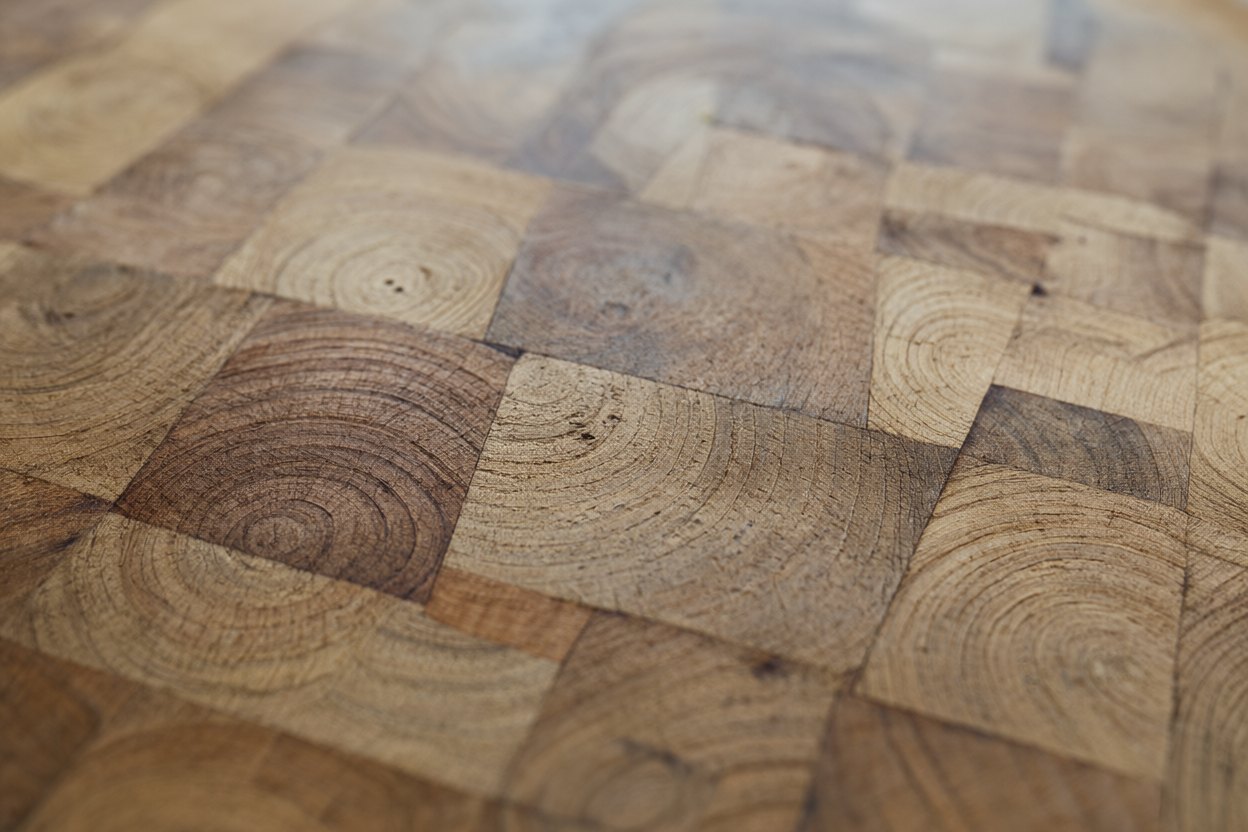
The same tree, cut two different ways. One face shows the long fibres laid side by side — flat grain. The other shows the fibre ends, packed together like a bundle of upright chopsticks — end grain.
Flat grain: a stack of planks
On a flat grain board, the knife enters a wall of fibres lying parallel to the surface. Each stroke bites into those fibres and pushes them aside, so the cut leaves a groove — a clean line where the fibres have been torn out.
That is honest, and perfectly fine for a butcher's block or a serving board. It is less good for a board you sharpen knives on every day.
End grain: a bundle of pillars
On an end grain board the fibres stand upright, perpendicular to the working surface. A knife falls between the fibres, closing the gap behind it as it lifts — the way grass springs back after a foot steps through. There is far less to tear.
Side by side
Flat grain vs end grain
Where the two constructions genuinely differ. "Gentler on knives" is not a myth — it is about where the cut lands.
| What you care about | Flat grain (butcher block, plywood) | End grain (Endmark) |
|---|---|---|
| How the knife meets the wood | Cuts across fibres laid parallel to the surface | Cuts between fibres standing upright |
| Visible knife marks | Grooves form where fibres tear out; they accumulate | Fewer marks; the gap closes as the knife lifts |
| Effect on a sharp edge | More wear per stroke — the cut shears fibre | Less wear per stroke — the fibres part rather than shear |
| Feel under the knife | Solid, slightly grabby | Cushioned, quiet |
| Repairing marks | Sanding removes them; depth is limited over years | Same, plus the surface is thicker and more forgiving |
| Cost & weight | Lighter and cheaper to make | Heavier and more material — you are buying the geometry |
| Water behaviour | Long, open channels for liquid to sit in | Shorter paths; the surface is denser |
A note on honesty: no chopping board is "bacteria-proof", and end grain is not a disinfectant. What end grain does is give fewer deep grooves for food residue and moisture to sit in, and fewer deep grooves are easier to wash than deep grooves. Clean every board — any board — with warm soapy water and a scrub, dry it promptly, and that covers what matters. See the care guide for the full routine.
Keeping it well
The care routine
Four minutes a week, properly done, and the board outlives you. Every Endmark board includes a tin of our food-safe linseed-and-beeswax oil.
After each use
Wash with warm water, a drop of mild soap and a soft cloth or sponge. Stand it upright or lay it flat to air-dry before storing. Never a dishwasher — the heat and agitation open the grain and crack the glue — and never a prolonged soak, for the same reason.
Once a month
Wipe a thin film of food-safe oil over the whole surface, let it drink in for a couple of hours, then wipe off the excess. If the board looks pale or a water ring appears in the wood, it wants oil — re-oil it, don't worry about it.
Once a year, or when the surface looks tired
Light knife marks fade naturally with use and oil. Deep scratches and a tired surface get a quick resurface: sand lightly along the surface, wipe clean, re-oil. We'll resurface any board we've made, for life — send it back, we sand it, we oil it, it comes home looking new.
Keep it out of
Prolonged direct sun (it fades maple and cherry), a windowsill in summer, and the boot of a car. A stable, room-temperature place in the kitchen is all it asks.
Ready when you are
Seventeen boards. One honest construction.
Every board in the shop is end grain, made to order, signed and numbered.